
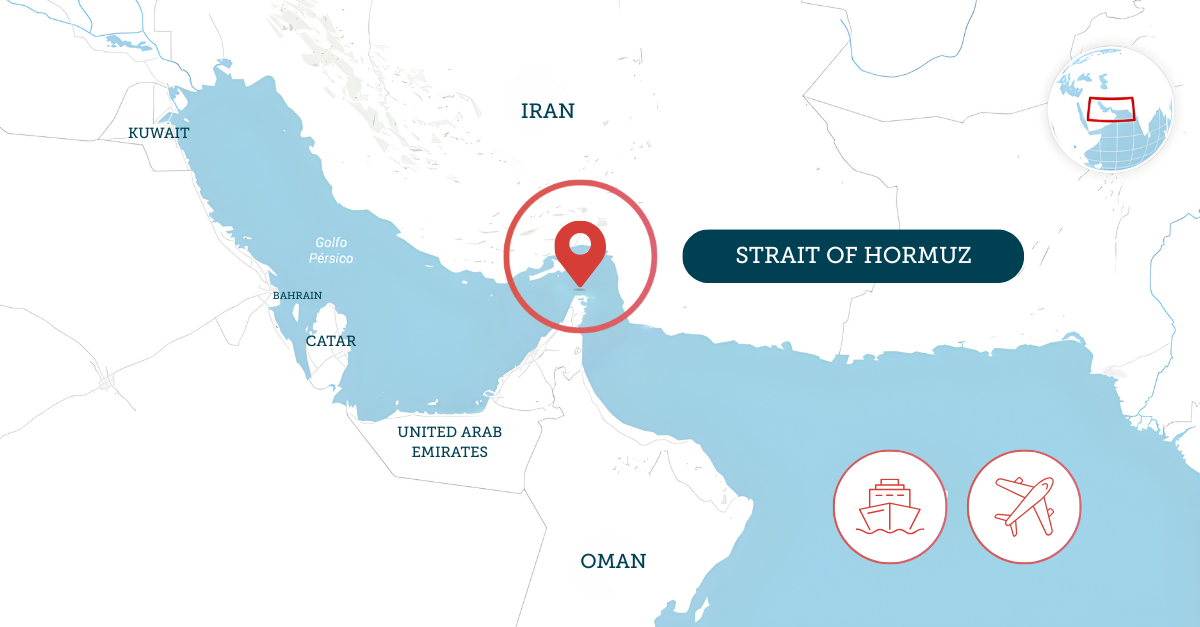
The recent Israeli and U.S. attack on Iran has raised the level of uncertainty in a strategic area for major international trade routes. With the focus on the Strait of Hormuz and regional airspace, companies are adjusting their transportation plans, hedging and costs in the face of an uncertain scenario that is already impacting global logistics.
In practice, the immediate effect translates into longer routes, higher fuel consumption, cost overruns associated with the risk of attack and a delay forecast that may affect both Asia-Europe flows and imports and exports linked to the Middle East.
Maritime transport: restructuring of routes and surcharges
As for the impact on maritime transport, Iran has announced the closure of the Strait of Hormuz, a strategic passage through which a very relevant part of the world’ s oil and gas transits . It also includes merchant ships that travel long maritime routes. This situation puts upward pressure on energy prices and, consequently, on logistics costs (fuel, surcharges, insurance and freight).
In addition, operational warnings to maritime traffic describe a high-risk environment , with significant military activity and potential interference complicating navigation and safety.
The increased risk is already translating into commercial measures such as war risk surcharges and coverage changes. In fact, several marine insurers have announced the withdrawal or cancellation of war-risk routes in the region, which tends to make premiums and operations more expensive.
The situation in air transport
Air transport is also suffering a direct impact. Eight countries have announced the total closure of their airspace (Iran, Israel, Iraq, Jordan, Qatar, Bahrain, Kuwait and the United Arab Emirates), with immediate effects such as cancellations, diversions, increased flight times and fuel surcharges.
Such restrictions strain connectivity between Europe and Asia, where the Middle East acts as a natural corridor. Air routes can experience delays of between 45 and 120 minutes on long-haul flights and congestion at alternative airports.
At Operinter, as an international logistics company, we closely follow the evolution of the situation and continuously monitor its impact on the main maritime and air routes. Our priority is to anticipate the context and adapt at all times, activating operational alternatives when necessary. The objective is to guarantee safe and efficient logistics solutions with the utmost resilience and professionalism towards our customers.